
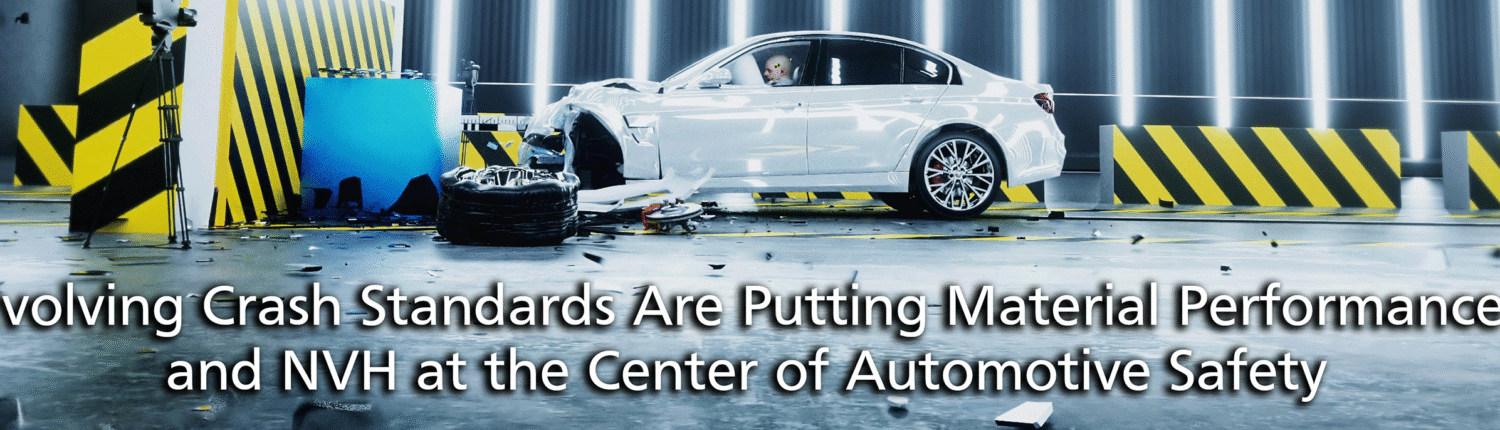
Evolving Crash Standards Are Putting Material Performance at the Center of Automotive Safety
Crash safety is no longer defined by a single moment of impact. It is defined by how a vehicle performs before, during, and after an incident.
Testing is evolving to better reflect real-world conditions including:
- Multi-angle collisions
- Heavier vehicles, and
- Post-crash scenarios.
Due to this, material performance is becoming more critical. Safety outcomes increasingly depend on how materials respond to mechanical stress, heat, and environmental factors.
Real-World Conditions Are Exposing Material-Level Challenges
Traditional crash testing relied on controlled impacts that didn’t fully capture real-world variability.
Modern protocols introduce more complex conditions, especially for EVs where crashes involve both structural and thermal factors. In these scenarios, materials between systems play a key role in managing energy, movement, and durability under stress.
Managing Heat, Vibration, and Movement Under Stress
Many challenges come down to controlling heat, vibration, and mechanical load.
Exhaust components must remain sealed while accommodating movement and temperature changes. ACS hot-end and cold-end seals and gaskets use compressed knitted wire mesh to absorb vibration, allow expansion, and maintain integrity under changing conditions.
Thermal Stability and Electrical Safety After Impact
In EVs, crash safety includes high-voltage risks.
Pyrotechnic disconnect systems cut power instantly but generate high-energy arcs. ACS porous metal filters act as heat sinks to safely dissipate that energy, using proven airbag filter expertise to ensure reliable performance at scale.
Manufacturing Consistency Is Directly Linked to Safety Outcomes
As testing becomes more advanced, variability is easier to detect.
Consistent material performance across high-volume production is critical. ACS manufacturing processes ensure repeatability and predictable behavior under stress.
From Materials to Real-World Safety Performance
Crash testing now reflects real-world conditions, redefining how safety is measured. It depends not just on structure, but on how materials
· absorb energy
· manage heat, and
· maintain integrity.
For OEMs, the challenge is no longer just passing a test; it’s delivering consistent performance at scale. Materials are now a defining part of automotive safety.
Let’s Build for Real-World Safety
If you are developing next-generation vehicle platforms, ACS Industries can support your material and component needs. Our team works with OEMs to deliver solutions that meet evolving safety requirements with the consistency and scalability needed for production.
Reach out to discuss how we can support your next program.