
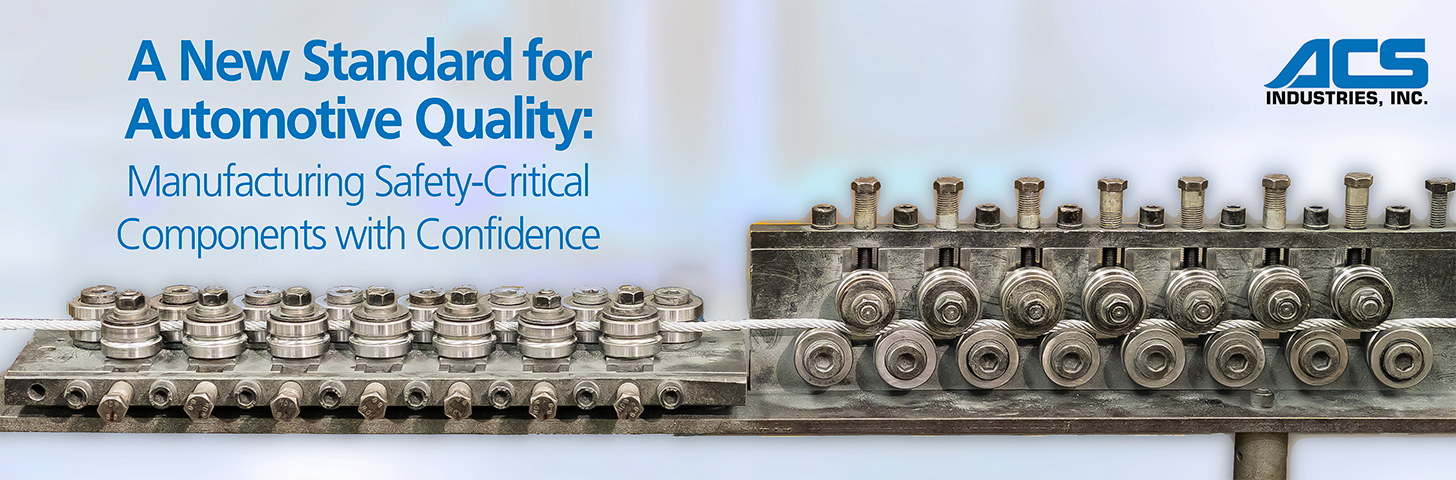
A New Standard for Automotive Quality: Manufacturing Safety-Critical Cables and Ferrules with Confidence
Quality expectations across the automotive supply chain continue to rise. For safety-critical components, manufacturers must do more than produce parts that meet specifications. They must demonstrate control over the entire manufacturing process and deliver consistent performance across every production run.
In June 2026, AIAG and VDA introduced a new harmonized Statistical Process Control handbook for the global automotive industry. The handbook emphasizes process capability, early detection of variation, and consistent quality practices across international supply chains. For automotive OEMs and Tier suppliers, its introduction reflects a broader industry shift toward preventing defects before they occur.
Small Components with Critical Responsibilities
Automotive cables and ferrules perform essential functions throughout a vehicle. They are used in seat belt anchors, tailgate cables, latch systems, parking brakes, hood releases, control cables, EV battery restraint systems, and other motion-control applications. Although these components may be small, their performance can directly affect occupant safety and vehicle operation.
Producing them consistently requires control over cable construction, ferrule dimensions, crimp integrity, assembly length, and load capacity. Even minor variations can contribute to assembly problems, inconsistent performance, or increased risk in the field. This makes process control especially important when components are produced in high volumes for safety-critical applications.
Building Quality into the Manufacturing Process
Final inspection is important, but it cannot replace a well-controlled production process. Quality must be established at every stage of manufacturing, from material selection and component forming through assembly and final verification.
ACS uses fully integrated automation to support high-volume production with tight tolerances and exceptional repeatability. Tool-controlled dimensions and error-proofed process sequencing help ensure that each component moves through the correct production steps. Inline inspection and vision validation identify potential issues during production, while proof load testing verifies that finished assemblies meet their required performance criteria.
Together, these controls help reduce variation, prevent defects, and provide customers with greater confidence in every shipment.
Supporting a Range of Automotive Applications
Different automotive applications require different combinations of strength, flexibility, fatigue resistance, abrasion resistance, and corrosion resistance. Selecting the appropriate wire rope construction is therefore an important part of component design.
ACS offers multiple wire rope constructions, including 1 x 7, 7 x 7, 1 x 19, and 7 x 19 configurations. Available cable diameters range from 0.9 mm to 7.7 mm, supporting a broad range of load-bearing and motion-control applications. This flexibility allows ACS to develop cable and ferrule components around the specific performance and packaging requirements of each automotive program.
More Than a Component Purchase
For purchasing and supply chain teams, selecting a cables and ferrules supplier involves more than comparing piece prices. Manufacturing consistency can influence assembly efficiency, scrap, rework, warranty exposure, and overall program risk. The right supplier must combine competitive production with reliable quality, scalable capacity, and application-specific manufacturing expertise.
As automotive quality practices become more globally aligned, robust process control will become even more important. With decades of experience in occupant safety systems, advanced automation, and safety-critical manufacturing, ACS Industries is prepared to support the next generation of automotive cable and ferrule applications.
Contact us today to dicuss your automotive cable and ferrule requirements.