
FUEL CELL COMPONENTS
Expanded metal and wire mesh are used in a variety of structural, electrical, and fluid-management applications within fuel cells, including proton exchange membrane fuel cells (PEMFC), solid oxide fuel cells (SOFC), and alkaline fuel cells (AFC). Offering high strength, excellent conductivity, low weight, and open flow paths, expanded metal and wire mesh are often preferred materials that optimize performance at a cost-effective price point.
As a leading manufacturer of fuel cell components for green energy applications, including stamped bipolar plates and expanded metal flow fields, ACS Industries is committed to delivering optimal performance, efficiency, and reliability for your fuel cell systems. We offer a comprehensive range of solutions, encompassing both individual components and advanced production processes.
Contact us today to learn more about our fuel cell component manufacturing solutions.
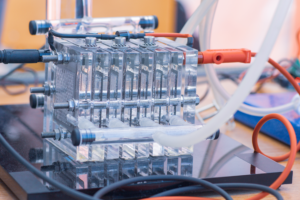
GLOBAL MANUFACTURING OF MANY FUEL CELL COMPONENT TYPES
With a global network of locations, ACS Industries manufactures green energy solutions from locations in the USA, China, Mexico, India and Romania. Our international operations allow us to provide supply chain flexibility, to scale up production quickly, and to provide localized service to customers around the world.
Offering a wide variety of manufacturing processes, we produce many types of fuel cell components including:
- Bipolar plates
- Gas diffusion layers (GDL)
- Current collectors
- Flow fields
- Membrane electrode assemblies (MEA)
- Compression plates
- Flexible bus bars
- End plates
- Shielding mesh
ACS Industries components are ideal for use in hydrogen vehicles, power systems, backup power and aerospace applications. Our experienced engineering team is ready to review your design and advise on manufacturability, performance and material solutions that can improve reliability and optimize costs. Contact us to schedule a call with our engineering team.
Custom wire mesh and expanded metal manufacturing provides a variety of advantages for fuel cell components compared to alternatives such as machined plates, molded plastics, sintered metals, or stamped solid sheet structures. These benefits are particularly relevant in components such as flow fields, current collectors, electrode substrates, and bus bars, including:
- Improved gas and fluid distribution: With open, interconnected structures, expanded metal and wire mesh allow gases and liquids to flow efficiently, supporting uniform reactant distribution and improved performance.
- High electrical conductivity: Many fuel cell components require efficient electron transfer. Expanded metal and wire mesh provide continuous conductive pathways and large contact areas that help reduce contact resistance.
- Weight reduction: Expanded metal is produced by slitting and stretching sheet metal, which reduces the material required while maintaining structural integrity. This results in a high strength-to-weight ratio and lower component weight.
- Structural strength and stack compression support: Fuel cell stacks operate under significant compression to maintain sealing and electrical contact. Expanded metal and wire mesh can provide rigidity and elastic compliance, support delicate components such as membranes or catalyst layers, and help ensure consistent electrical contact and load distribution while maintaining proper gas flow.
- High surface area: The geometry of mesh and expanded metal creates large active surface areas, improving interaction between gases, electrodes, and conductive pathways.
- Thermal management: Metal meshes and expanded structures conduct heat effectively while still allowing gas flow, supporting improved temperature control within the stack.
As demand increased and fuel cell component designs continue to evolve, expanded metal and wire mesh are increasingly in demand. Some of our most common fuel cell applications include:
- Expanded metal for current collectors
- Knitted wire as a superior alternative to nickel foam
- Flexible bus bars
- Automation of production including tab welding to expanded material
- Shielding mesh
- Shock absorption
- Thermal runaway protection
CUSTOM MANUFACTURING CAPABILITIES FOR FUEL CELL COMPONENTS
With its customizable geometry, expanded metal and wire mesh provide engineers with opportunities to tailor designs and influence fuel cell performance, including properties such as flow resistance, conductivity, mechanical stiffness, and surface area. This design flexibility is often more difficult to achieve with solid plates or molded components.
With large scale manufacturing capabilities, ACS Industries can produce custom expanded metal and wire mesh with precise control over:
- Mesh opening size
- Strand width
- Thickness
- Pattern orientation
- Materials and coating
Our experienced team of engineers will collaborate closely with you to analyze your specific requirements and develop fuel cell components that seamlessly integrate with your unique fuel cell system design. Whether you need adjustments to material properties, size specifications, or new component configurations, we have the expertise and flexibility to bring your fuel cell component vision to reality. Reach out to our team today.
COST-EFFICIENT FUEL CELL COMPONENT MANUFACTURING AT SCALE
Compared with machining complex flow channels or producing sintered porous metals, expanded metal and woven mesh can often be produced more efficiently. This becomes important as fuel cell manufacturers scale production. ACS Industries provides global manufacturing expertise, providing a variety of production processes to efficiently produce fuel cell components. Our expanded metal and wire mesh fuel cell components offer unique advantages versus other component types, with advantages including:
- Minimal material waste
- Fewer secondary machining operations
- Lower tooling costs compared with precision machining
This allows for cost-effective manufacturing, especially as volumes increase, for fuel cell components.
Where is expanded metal or wire mesh used in a fuel cell?
Expanded metal and wire mesh solutions are typically used in 3-5 key component areas within a fuel cell stack, commonly including flow fields, current collectors, gas diffusion layer supports, bipolar plate structures (in some designs), and bus bars. The specific application depends on the fuel cell design and performance requirements.
What types of materials are used in expanded metal and wire mesh in fuel cell components?
With custom manufacturing, material options are extensive, however common material types include stainless steel (304, 316/316L and ferritic grades), nickel and nickel alloys, copper, aluminum, and titanium alloys are often used depending on the operating environment and performance requirements.
What types of material coatings can improve the performance of metal and wire mesh fuel cell components?
Expanded metal and wire mesh fuel cell components are often coated to improve corrosion resistance while maintaining electrical conductivity. Common coatings including gold, silver, platinum, carbon, graphite, titanium nitrate and other conductive ceramic coatings. These coatings help prevent metal ion contamination, reduce interfacial resistance and improve chemical durability.
What are expanded metal flow fields in fuel cells?
Expanded metal flow fields are conductive structures made from expanded metal sheets that are used inside fuel cells to distribute reactant gases across the active electrode area. Instead of relying on machined or stamped channels, these structures use the open lattice geometry of expanded metal to guide the flow of gases such as hydrogen and oxygen through the cell.
Why are expanded metal flow fields better than machined or stamped channel plate flow fields in fuel cells?
While the optimal design of a component depends on a fuel cell’s unique structure, application and configuration, expanded metal flow fields often improve gas distribution and flow, provide larger contact surface areas for better electrical conductivity, are lighter, and more cost effective to manufacture compared to machined or stamped channel plate designs.
What should I look for in expanded metal and wire mesh fuel cell component suppliers?
Fuel cell component manufacturers should have experience working with high-performance materials and producing complex geometries. The ability to provide manufacturability support is also important, helping reduce production costs while maintaining quality and regulatory compliance. Suppliers should also have advanced manufacturing capabilities and rigorous quality control processes in place to ensure reliability and consistent performance.
At ACS Industries, our robust quality standards are applied across our global manufacturing facility network, ensuring our products meet even the strictest compliance and regulatory requirements. Learn more about our quality control processes.
CONTACT US ABOUT YOUR FUEL CELL COMPONENT REQUIREMENTS
If you are searching for a reliable source for PEM electrolyzer and fuel cell components, or if you would like to know more about our advanced solutions in the green energy sector, please contact us or fill out the form below.