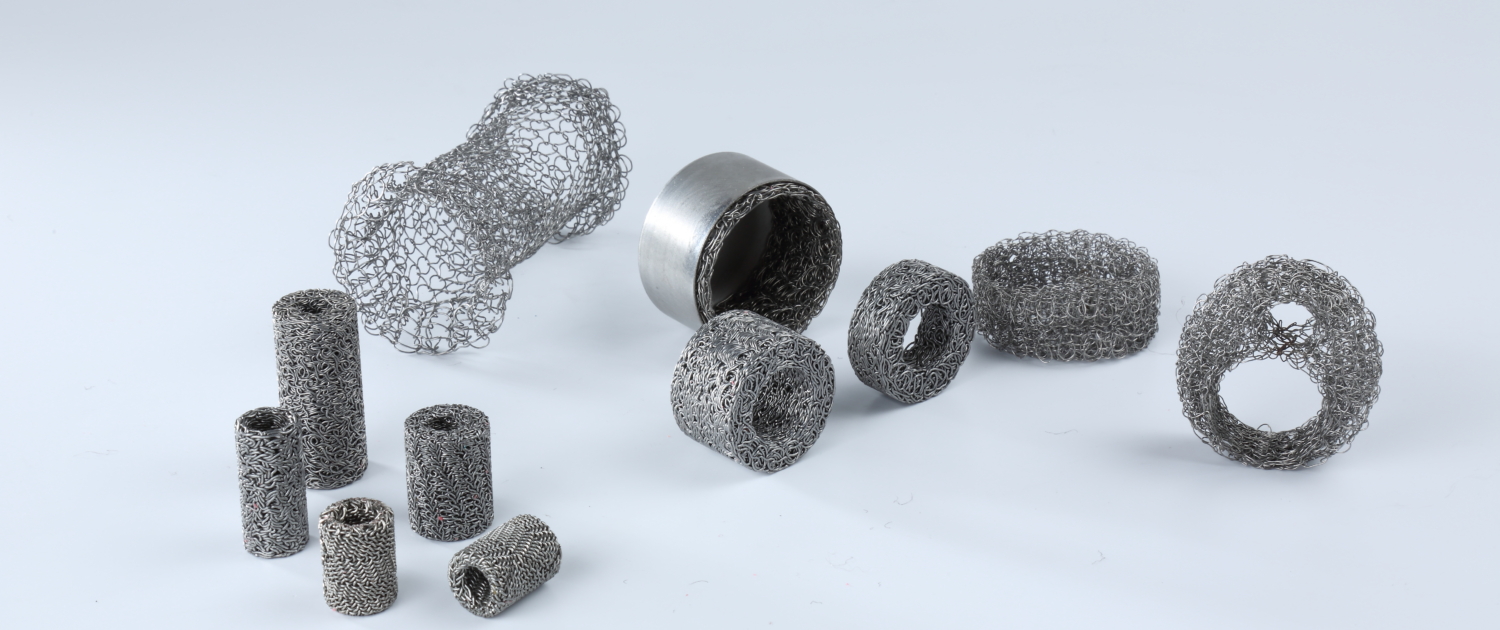
Knitted wire mesh is a customizable engineered material that is formed by interlocking metal wire into compressible, porous structures. Often used filtration, vibration damping, thermal protection, pressure venting, and EMI shielding, metal wire mesh is designed into larger systems to improve equipment performance, safety, and efficiency.
Since 1946, ACS Industries has designed and manufactured engineered knitted wire mesh solutions for applications in virtually every industry. From our industry-leading R&D Department to the world’s largest vertically integrated manufacturing process, we offer the capability and capacity meet our customers’ demands. We specialize in manufacturing customizable knitted wire mesh for the automotive, industrial and insulation industries.
Review some of our common knitted wire mesh diameter and material considerations or contact our team today to discuss your unique requirements.
Calendared Mesh & Mesh-Core Cable
We designed our Mesh and Mesh-Core cable for use primarily in high-temperature or cryogenic seals and gaskets. During the design phase, we choose wire types specifically for their resistance to certain destructive elements. This increases the resistance of Calendared Mesh and Mesh Core Cable to temperature extremes, corrosion and otherwise destructive elements. Additionally, the spring composition of Knitted Wire Mesh gives it an inherent resistance to mechanical wear.
Common Applications for Knitted Wire Mesh
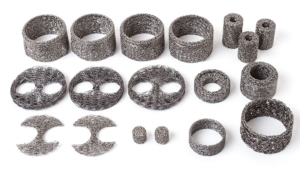
Knitted wire mesh is a remarkably versatile material used across a range of industries. At ACS Industries, our global operations and vertically-integrated processes allow us to design and manufacture prototypes and high-volume wire mesh lots for customers around the world. From sub-millimeter filtration to high temperature knitted wire mesh applications, our experienced engineers can partner with you to develop a solution that delivers reliable performance at a cost-effective price.
Some of our common knitted wire mesh applications include:
Automotive
- Catalytic converter support and retention media
- EMI/RFI shielding of sensors, instruments and ECU housings
- Emission control
- Exhaust vibration and machinery dampers
- Mesh optimized for heat shielding
- Urea mixers for Selective Catalytic Reduction
Aerospace
- Durable high temperature seals
- Thermal management mesh solutions
- Flame arrestors and explosion suppression
- Fuel tank venting systems
- Vibration isolation and damping components
- Breather vents for gearboxes, hydraulic systems and enclosures
Filtration & Separation
- Industrial process filtration
- Liquid & gas coalescers
- Vapor-liquid separation in towers and columns
Thermal & Acoustic
- Acoustic absorption and noise control panels
- Cryogenic pipe insulation systems
- Engine and equipment sound mufflers
- Insulation products & supporting media
Oil, Gas & Chemical
- Flame arresting and explosion suppression components
- Pipeline pig launcher filtration and debris capture
- Pressure vessel breathers and vent systems
- Reactor bed and catalyst support media
Electronics & Sealing
- Breathable barriers for dust and moisture protection
- EMI/RFI shielding gaskets for enclosure and panel seams
- Environmental and weather proof sealing
- Metal gaskets and compression seals
- Vent filters and pressure equalization elements
From prototyping to mass production scale up, ACS Industries is ready to be your one stop resource for your knitted wire mesh solutions.
Custom Knitted Wire Mesh Materials
ACS Industries is recognized by many of the world’s leading brands for our ability to efficiently manufacture metal knitted mesh for industrial applications. Our engineers can review your design and advise on manufacturability, geometry and material selection.
Material selection is typically guided by four factors: operating temperatures, chemical environments, mechanical requirements – such as strength – and cost. Our engineers can help you optimize material selection to your unique requirements.
Some of the common metals used in our wire mesh manufacturing processes include:
- Stainless Steel (304 / 309 / 310 / 321) – Due to its reliable performance and cost-effective price point, stainless steel is our most common material used for industrial wire mesh.
- Stainless Steel (316 / 316L) - With added molybdenum, SS 316/316L provides improved resistance to chlorides and acids, and is often used in chemical processing, marine, and food/pharma applications.
- Inconel (625 / 718) - Selected when both high temperature and corrosion resistance are needed simultaneously, Inconel is often used in exhaust systems, gas turbine components, and furnace applications where stainless would oxidize or lose strength. With a high cost point, it is typically specified only when stainless falls short.
- Monel (400) - This nickel-copper alloy offers exceptional resistance to seawater, hydrofluoric acid, and alkalis. It is common in offshore oil and gas, desalination, and chemical plant applications.
- Titanium - Specified where the combination of very low weight, high strength, and outstanding corrosion resistance is critical, titanium is often used in aerospace filtration, medical devices, and highly oxidizing acid environments. Similar to Inconel, its high cost limits titanium to high-value applications.
- Copper and Brass - Selected primarily for electrical conductivity rather than structural performance, these materials are often used in EMI/RFI shielding gaskets where maximum conductivity is needed. Typically, brass offers slightly better corrosion resistance, while copper offers better conductivity.
- Aluminum - Lightweight and corrosion-resistant in mild environments, aluminum is often used in EMI shielding and aerospace breather vents where weight is a primary constraint and temperatures are moderate.
- Nickel 200/201 - This material used in electronic applications for its resistance to caustic soda (sodium hydroxide) service, ability to resist high-temperature oxidizing environments, and for its magnetic properties.
- Hastelloy (C-276 / C-22) - The most chemically resistant metal commonly selected, Hastelloy is specified for harsh wet chemistry environments that typically involve mixed acids, chlorine, and oxidizing/reducing conditions. With its higher price point, this material is typically reserved for demanding chemical processing duties.
With decades for design and manufacturing experience for knitted wire mesh solutions, our team can support material selection for your unique application and project requirements. Contact us today, or send us a design for review.
Frequently Asked Questions About Metal Wire Mesh Manufacturing
What wire diameters and mesh densities are available?
While our ability to manufacture metal wire mesh solutions is based on customer needs, our common wire diameters include 0.006”, 0.008”, 0.0095” and 0.011” and we can draw wire down to a diameter of 25 microns. ACS manufactures knitted wire mesh to meet precise application-specific requirements for geometry, density, and performance characteristics. Our capabilities span from tightly compressed, structurally stable forms with rigorously controlled porosity to low-density, highly open mesh configurations engineered for maximum permeability and flexibility.
What is the most common metal used in wire mesh exhaust applications?
For automotive and emissions control exhaust applications, most often we knit metal mesh using Stainless Steel 309 or 310. Depending on application requirements, other steel alloys, or unique specialty metals, may be recommended. Our expert engineers can advise on material selection.
What is the difference between knitted wire mesh and woven wire mesh?
Knitted wire mesh and woven wire mesh are manufactured using different processes, which affect their structure and performance. Knitted wire mesh manufacturing connects wire into an interlocking series of loops. Woven wire mesh manufacturing interlaces straight wires over and under each other, forming a rigid, grid pattern. Knitted wire mesh is highly flexible, compressible and spring-like, and offers the ability to vary in density, as well as provides more open flow paths. Woven wire mesh is more dimensionally stable, with precise and uniform openings – giving a defined pore size and less compressible structure.
Generally speaking, knitted wire mesh is better for applications where flexibility, energy absorption or fluid coalescing are needed. Woven wire mesh is superior for applications that need dimensional stability, strength and consistent pore sizes. ACS offers both knitted mesh and woven mesh solutions as prototypes and large volume orders.
What is calendared wire mesh?
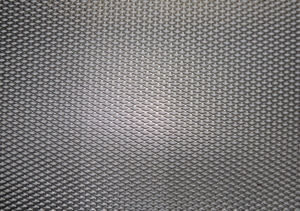
Calendared wire mesh is knitted mesh that has been processed by a series of rollers to compress, flatten and control the material’s thickness and density. Calendaring metal wire meshes allow for tolerance and dimensional controls, better contact surface area definition (important in conductivity), better filtration performance, and easier converting (such as cutting, stamping or layering).
How much does knitted wire mesh weigh?
Product weight varies based on several factors, including material type, wire diameter, knit density, and the number of plies (layers). At ACS Industries, we produce knitted wire mesh in a wide range of weights, specific to each order’s requirements. For example, a flat, two-ply mesh made from Monel 400 represents one of our lighter configurations at approximately 5.6 pounds per square foot, while a comparable two-ply mesh made from 304 stainless steel can weigh up to 19.5 pounds per square foot, depending on construction.
What wire mesh manufacturing, quality and process certifications does ACS maintain?
ACS Industries holds ISO 9001:2015, IATF 16949:2016, TISAX – ML3 High, and CTPAT certification. We are also experienced in PPAP (Production Part Approval Process) and we follow the 5 phases of APQP (Advanced Product Quality Planning). Read more about our Quality Standards.
Why Choose ACS as Your Knitted Wire Mesh Manufacturer
For more than 70 years, ACS Industries has delivered expert support and reliable manufacturing of knitted metal wire mesh solutions. With the manufacturing facilities across North American, Europe, and Asia, our team is able to provide localized support and a global supply chain network – delivering prototypes quickly and providing the ability to quickly scale up production. From design for manufacturing support, reviews of your ideal mesh geometries and application, or for material selection assistance, our team is ready to support your project.
For inquiries or to discuss your specific knitted wire mesh needs, please contact our knowledgeable team. We are here to provide expert guidance and offer customized solutions to meet your unique requirements.